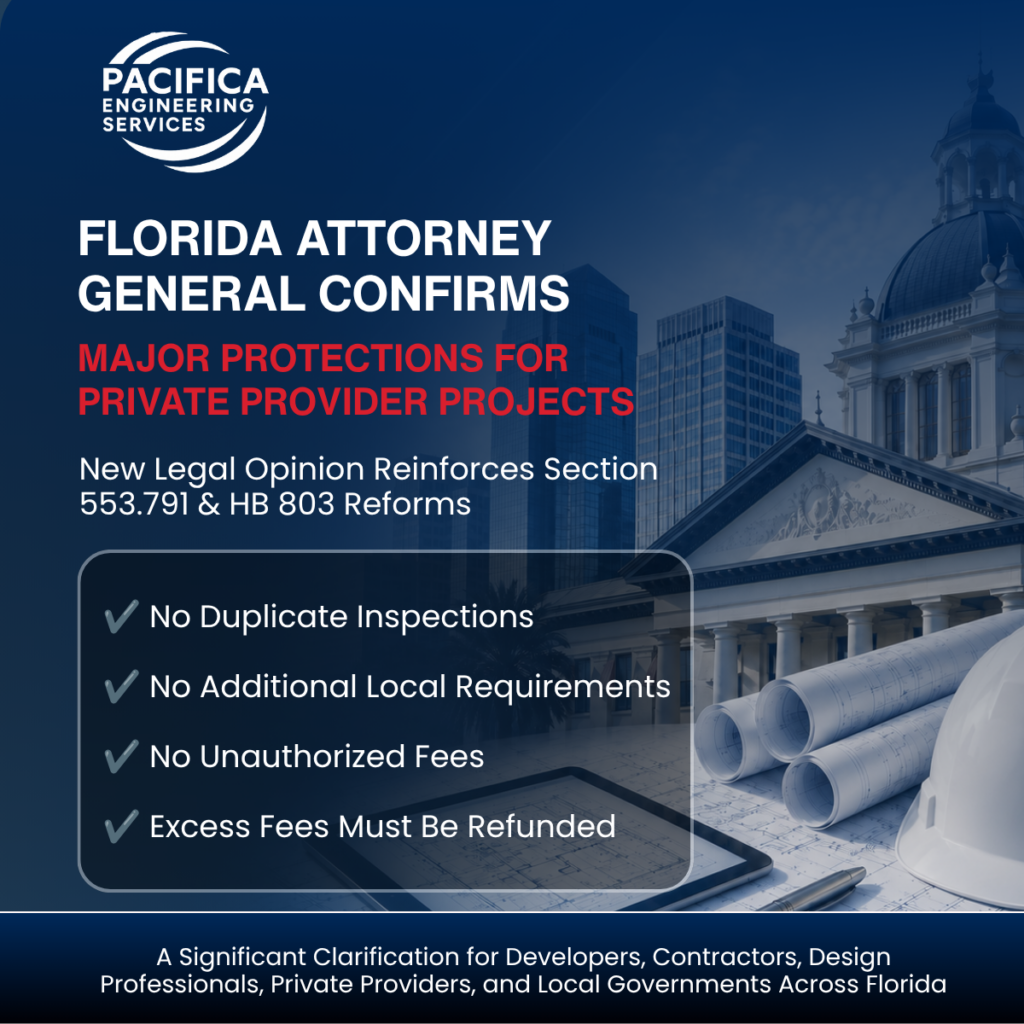
Florida’s permitting landscape continues to evolve following the implementation of House Bill 803. On July 16, 2026, the Florida Attorney General issued an important legal opinion that provides significant guidance for owners, developers, contractors, design professionals, private providers, and local governments operating under Section 553.791, Florida Statutes.
The opinion addresses several long-standing questions regarding the administration of projects utilizing private provider services and reinforces the Legislature’s intent to create a consistent statewide framework that reduces permitting delays, unnecessary costs, and duplicative requirements.
Local Building Departments Cannot Duplicate Private Provider Inspections
One of the most significant conclusions in the opinion is that local building departments cannot require inspections that duplicate inspections already performed by a properly retained private provider.
The Attorney General clarified that while local jurisdictions may conduct audits to verify that required inspections were completed and properly documented, an audit is not a second inspection process. Local governments may not establish parallel inspection procedures simply as a condition of permit closeout.
This distinction is critical. Building departments may verify compliance with statutory requirements, but they may not require additional site visits or inspections that replicate work already performed by the private provider.
The opinion recognizes limited exceptions where a building official has actual knowledge that a required inspection was not performed or where immediate public health and safety concerns exist. These exceptions do not create a general right to reinspect work that has already been inspected and approved by a private provider.
Local Requirements Cannot Be More Stringent Than State Law
The opinion also confirms that local governments cannot create additional private provider requirements beyond those established in Section 553.791.
The statute prohibits local enforcement agencies, building officials, and local governments from adopting or enforcing policies, procedures, qualifications, standards, or requirements that are more stringent than Florida law.
This prohibition applies regardless of whether the additional requirement is described as an internal policy, administrative procedure, permit-closeout requirement, or standard operating practice.
Examples of potentially prohibited practices include:
- Requiring additional inspections not authorized by statute
- Requiring duplicate site visits before issuing a Certificate of Occupancy or Certificate of Completion
- Imposing local qualifications or registration requirements beyond those permitted by law
- Requiring documents or agreements not authorized by statute
- Charging fees beyond those permitted under Section 553.791
The practical message is straightforward: Florida’s private provider program is governed by a statewide framework, and local jurisdictions must operate within that framework.
Permit Fees Must Reflect Services Actually Performed
The Attorney General’s opinion also provides important clarification regarding permit fees when an owner or contractor utilizes a private provider for plan review, inspections, or both.
While jurisdictions may continue to collect permit fees, those fees must reflect the services actually performed by the jurisdiction. If a private provider performs plan review, inspection services, or both, the permit fee must be reduced to account for the work no longer being performed by the local agency.
The opinion further concludes that jurisdictions may not charge separately for plan review or inspection services they do not perform.
This clarification aligns with the intent of recent legislative reforms and provides greater transparency for project teams evaluating permit costs.
Unauthorized Fees Must Be Refunded
One of the most impactful portions of the opinion addresses fees that have been improperly collected.
The Attorney General concluded that fees collected beyond what Section 553.791 authorizes must be refunded to the party that paid them.
This may apply to situations where owners or contractors were charged:
- Full plan review fees when plan review was performed by a private provider
- Full inspection fees when inspections were performed by a private provider
- Administrative fees not authorized by statute
- Duplicate inspection fees
- Charges for services the jurisdiction did not perform
Owners and contractors should carefully review permit invoices and fee schedules to ensure charges are consistent with Florida law.
HB 803 Establishes Minimum Permit Fee Reductions
The opinion also reinforces reforms established through House Bill 803, which became effective July 1, 2026.
Under the amended statute:
- When a private provider performs plan review or building inspection services, the local enforcement agency must reduce the portion of the permit fee attributable to that service by at least 25 percent.
- When a private provider performs all required plan review and building inspection services, the permit fee must be reduced by at least 50 percent.
- If a jurisdiction fails to provide the required reduction, it may forfeit its ability to collect permit fees for that commercial construction project.
These statutory minimums provide owners and developers with greater certainty regarding permit costs and strengthen the value proposition of utilizing private provider services.
What Project Teams Should Do Now
Owners, developers, contractors, architects, and engineers utilizing private provider services should take a proactive approach to compliance and documentation.
Recommended best practices include:
- Maintain complete private provider documentation throughout the project.
- Submit required reports, affidavits, and certificates within statutory deadlines.
- Review permit fee calculations at the beginning of the permitting process.
- Request statutory justification for additional inspections, documents, or fees.
- Monitor compliance with HB 803 permit fee reduction requirements.
- Work with experienced private provider professionals who understand Florida’s evolving regulatory framework.
Addressing these issues early can help avoid delays, disputes, and unexpected costs later in the project lifecycle.
A Significant Clarification for Florida’s Construction Industry
Although Attorney General opinions are advisory and not legally binding court decisions, they are widely regarded as highly persuasive authority and provide important guidance regarding the interpretation of Florida law.
This opinion provides meaningful clarification for project teams throughout Florida and reinforces the Legislature’s intent to preserve the integrity of the private provider program.
For developers, contractors, design professionals, and owners, the message is clear: local jurisdictions may verify compliance and protect public safety, but they may not duplicate properly completed private provider inspections, impose unauthorized requirements, charge for services they did not perform, or retain unauthorized fees.
How Pacifica Can Help
Pacifica Engineering Services provides Private Provider Plan Review and Building Inspection Services throughout Florida.
Our team works directly with owners, developers, contractors, architects, engineers, and local jurisdictions to establish compliant permitting processes, maintain required documentation, and keep projects moving efficiently from permitting through construction.
As Florida’s permitting environment continues to evolve under HB 803 and related legal guidance, Pacifica remains committed to helping clients navigate the process with confidence.
Source: https://shorturl.at/Z1rIF
For assistance with Private Provider Services, Building Inspections, Permit Expediting, or HB 803 compliance, contact Pacifica Engineering Services today.
Disclaimer: This article is provided for informational purposes only and does not constitute legal advice. Parties dealing with disputed fees, local government requirements, or statutory interpretation issues should consult qualified legal counsel.