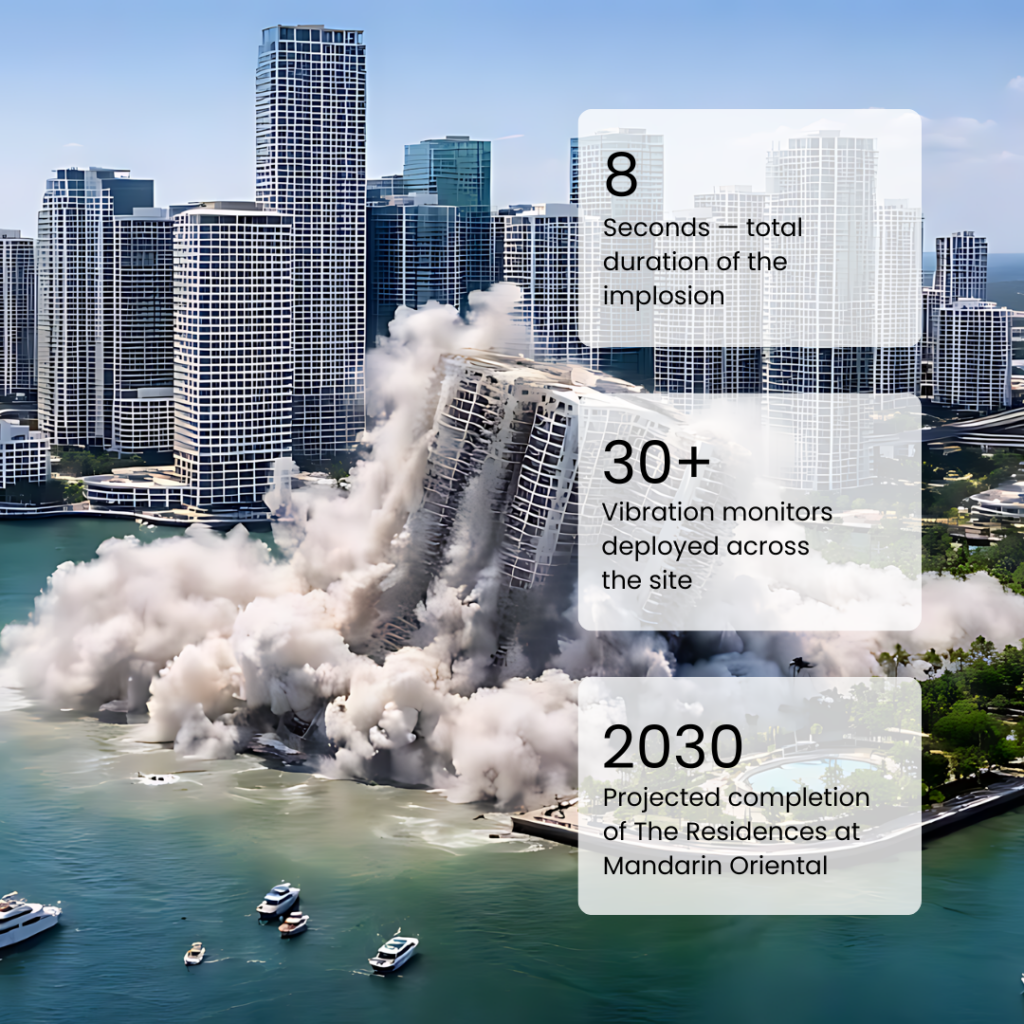
When the Mandarin Residences came down in the heart of Brickell, the implosion lasted less than half a minute. What most people did not see was the engineering work that made those 8 seconds safe and what it means for one of Miami’s most anticipated waterfront developments.
Controlled Demolition | Vibration Monitoring | Geotechnical Engineering | Miami
8 seconds — total duration of the implosion 30+ vibration monitors deployed across the site 2030 projected completion of The Residences at Mandarin Oriental
The building came down in 8 seconds. That is roughly the time it takes to read this opening sentence. It is also the number that tends to stick with people when they watch implosion footage. A structure that took years to build, gone in less than a quarter of a minute.
What that footage never captures is the months of work that made those 8 seconds controlled rather than catastrophic. Pacifica Engineering Services was proud to support the Mandarin Residences Implosion in Brickell, Miami. It was one of the most technically demanding demolition projects our team has taken on, precisely because of where it happened. Our principal engineer Chris Fernandez led the engineering effort, coordinating across contractors, city officials, and multiple disciplines to make sure the site, the surrounding neighborhood, and every adjacent structure came through without incident.
This is a breakdown of what that work actually looked like, and why the decisions made long before the first charge was set determined whether those 8 seconds went the way they did.
Why Brickell Changed the Difficulty Level
Not all controlled demolitions are created equal. An implosion on an isolated industrial site involves a completely different risk profile than one happening in a dense urban neighborhood. Brickell is about as urban as it gets in Miami.
The buildings surrounding the site were not across a field or down the block. They were close. That proximity meant every phase of planning had to account for neighbors in a way that a more remote demolition simply does not require. Safety perimeters, vibration thresholds, debris containment, monitoring placement — all of it was shaped by the fact that this was a populated area with occupied structures nearby.
Then there was the ground itself. Miami’s waterfront geology tends to be soft and often saturated, particularly in areas close to Biscayne Bay. That is not unusual for South Florida, but it creates a real engineering complication during demolition monitoring. Ground vibrations do not travel the same way through loose, wet soil as they do through denser substrates. The soil conditions near the water’s edge required us to adjust where several monitors were placed. We could not simply put them where the original layout called for because the ground would not give us reliable readings from those positions. That is not the kind of thing you improvise around on the day of the implosion. It is exactly the kind of issue that gets resolved in the planning phase, which is why early geotechnical awareness matters so much on projects like this.
A note on waterfront soil: Loose or saturated soils near water can amplify or redirect vibration energy in ways that denser ground does not. On a site like this one in Brickell, that changes where monitoring equipment can be placed and how the resulting data needs to be interpreted. Geotechnical knowledge and vibration monitoring are not separate disciplines on a project like this. They inform each other directly.
What More Than 30 Vibration Monitors Actually Tells You
We deployed over 30 vibration monitors across the site and surrounding properties. That number sometimes raises eyebrows. It sounds like a lot. But there is a straightforward reason for the coverage density.
A single monitor gives you a data point. It tells you what happened at one location. Thirty plus monitors give you a map. You can see how vibration energy moved across the site, whether it dispersed as modeled, whether any particular direction saw unexpectedly elevated readings, and whether every adjacent structure stayed within safe thresholds from the first detonation to the last.
In a tight urban environment like Brickell, that kind of spatial coverage is the only way to actually know what happened. If a single monitor had flagged an anomaly, the broader network would have told us whether that was a localized condition or something more widespread. As it turned out, the readings confirmed what the engineering predicted. But that confirmation only carries weight because the monitoring network was comprehensive enough to genuinely catch a problem if one had existed.
The documentation angle
There is an aspect of vibration monitoring that does not get talked about enough. The records matter long after the implosion is over. When a major demolition happens in a dense neighborhood, nearby property owners, city officials, and insurers all want to know whether their assets were affected. Detailed, timestamped monitoring data answers that question with evidence rather than assurances. It protects the developer, the contractor, and every neighboring property owner. It closes the door on disputes before they start.
For projects in populated urban areas, solid documentation is one of the primary reasons you invest in this level of monitoring rigor.
How the Implosion Itself Was Engineered
The 8 second duration is a product of deliberate sequencing. A controlled implosion is not a simultaneous detonation. It is a precisely timed series of charges designed to create a specific failure pattern in the structure. The goal is to direct the collapse inward, toward the building’s own footprint, rather than letting it fall unpredictably outward.
Getting that sequence right requires a detailed understanding of how the structure is loaded, where its weaknesses are, and what happens to the remaining building at each stage of the collapse. Detonate out of order and you lose control of the failure pattern. The 8 seconds that observers saw was the visible result of calculations that determined exactly how each charge related to every other charge in the sequence.
Chris Fernandez and the project team worked through that engineering in close coordination with the demolition contractors and city officials well before execution day. By the time the implosion happened, every decision had already been made and reviewed. Execution day was the culmination of that planning, not the beginning of it.
Engineering Oversight Across the Full Project Scope
Vibration monitoring and implosion sequencing were the most visible parts of Pacifica’s involvement, but they were not the only ones. A project of this complexity requires engineering oversight across multiple workstreams running in parallel.
That included construction materials testing to verify structural data used in planning, special inspections to confirm compliance with Florida engineering standards at each phase, and environmental consulting to assess broader site impacts. Each of those disciplines fed into the overall risk picture. Each one required coordination with the others rather than operating in isolation.
This is one of the reasons that having multidiscipline engineering support under a single firm matters on complex projects. When the geotechnical team’s findings about soil conditions directly affect where the monitoring team places sensors, those two groups need to be talking to each other continuously. They should not be submitting separate reports to a general contractor who then has to reconcile them. On the Mandarin Residences project, that integration was built into how the work was structured from day one.
What This Site Becomes and What Comes Next for the Engineering
The implosion cleared the way for The Residences at Mandarin Oriental, Miami, a luxury waterfront development currently scheduled for completion in 2030. That transition from demolition to new construction is its own engineering chapter.
Once a structure comes down, the site has to be reevaluated from the ground up. Soil that was tested and characterized before demolition may behave differently after it. Foundation remnants need to be assessed. The subsurface conditions that will support the new building’s design loads have to be confirmed, not assumed. Compaction testing, soil stability verification, and concrete materials testing for new construction are all part of getting a cleared site ready for vertical work.
The vibration monitoring data from the implosion also gives the engineering team useful baseline information. It shows how the soil on this specific site responds to significant ground stress events. That context is worth having as the new foundation design is finalized.
Pacifica supports projects through this full lifecycle, from pre-demolition planning through post-demolition site preparation and into new construction oversight. The engineers who understood the site during demolition are the same ones who can speak to its conditions going forward.
Five Things This Project Reinforces for Florida Developers and Contractors
The Mandarin Residences Implosion was not a typical project. But the lessons it demonstrates show up in some form on most complex Florida construction and demolition jobs.
Get engineering involved early. The soil complication that required us to adjust monitor placement was caught and resolved in planning. Discovered on execution day, it would have been a serious problem. Early involvement gives engineering teams time to adapt.
Coverage density in monitoring is not overkill. In a populated urban area, knowing what happened at 30 locations is categorically different from knowing what happened at five. The data tells a story. Sparse data tells an incomplete one.
Soil conditions are not background noise. Miami’s waterfront geology is genuinely variable and can meaningfully affect both vibration behavior and monitoring strategy. That is a site specific factor, not a generic one.
Documentation is part of the deliverable. Timestamped monitoring records protect every party involved long after the dust has settled.
Demolition and development are the same project. How a site comes down affects how it gets built back up. Engineering continuity across both phases is an advantage worth planning for.
Florida’s Growth Is Not Slowing Down and Neither Is Project Complexity
Miami, Tampa, Orlando, Fort Lauderdale — development across Florida continues to accelerate. The projects getting proposed today are bigger and more complex than they were five years ago. That means demolition projects happening in denser areas, new construction on sites with complicated histories, and more situations where the margin for error is tighter than anyone would prefer.
The Mandarin Residences Implosion is a useful reference point for what responsible execution looks like in that environment. Real data, comprehensive monitoring, engineering oversight that runs from early planning through execution, and documentation that holds up if anyone asks questions later. That is not an extraordinary standard for an unusual project. It is the baseline for doing this kind of work well.
Pacifica Engineering Services provides geotechnical engineering, vibration monitoring, construction materials testing, special inspections, and environmental consulting across Florida. If you are working on a project that needs this kind of support, whether that is demolition, new construction, or both, our team is built to move quickly and work across disciplines without the coordination gaps that slow projects down.